
How to Eat Naan with Indian Curry: Tearing, Scooping & Pairing Explained
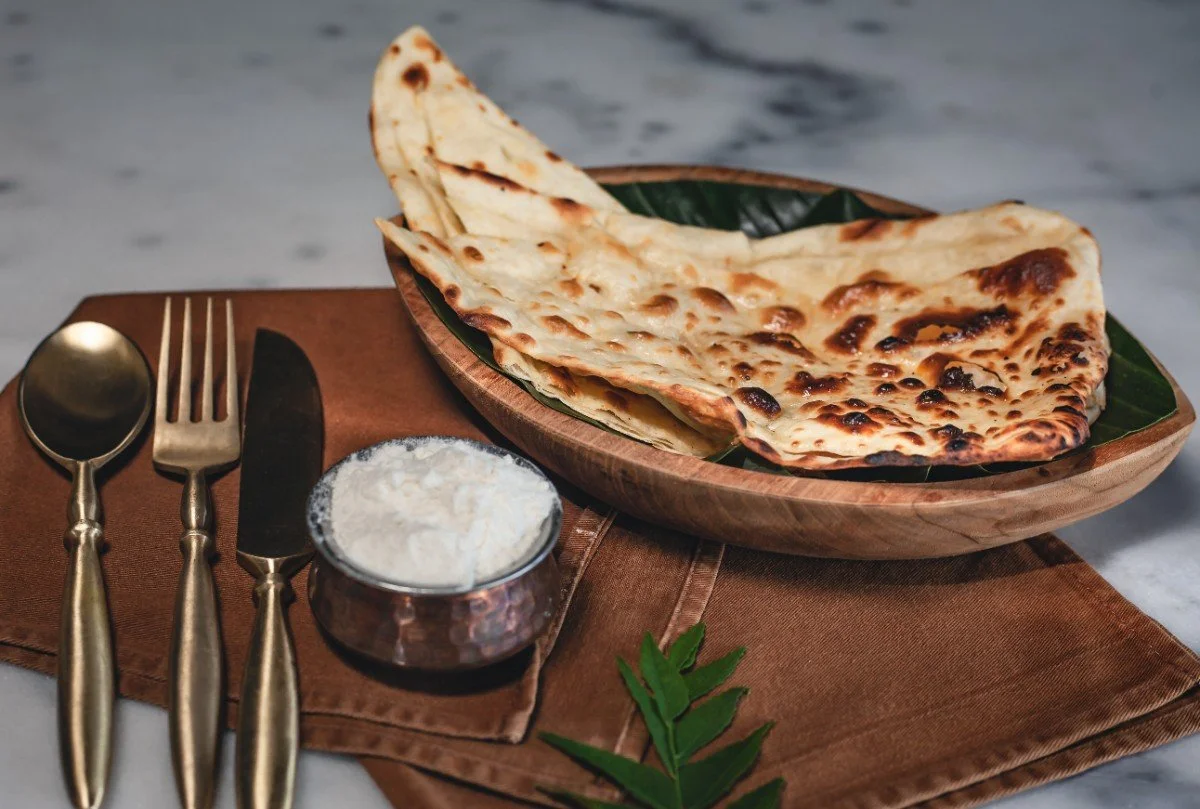
If you are wondering how to eat naan with curry, the simplest answer is this: tear off a small piece, fold it slightly between your fingers, and use it to pick up a manageable amount of curry.
You do not need a knife. You do not need to master a complicated dining ritual either.
Naan works particularly well this way because its soft but slightly chewy texture can hold sauce, paneer, vegetables, or small pieces of meat without immediately falling apart. It becomes part of the bite rather than simply sitting beside the meal.
There is also no single rule that every Indian diner follows. India has many regional, family, and personal dining traditions, and using a spoon or fork in a restaurant is completely normal. Think of tearing and scooping as one traditional and practical way to enjoy naan, not a test of whether you are eating Indian food “correctly.”
Why Is Naan Usually Torn Instead of Cut?
A fresh naan arrives as one larger flatbread, but you rarely need the whole piece for a single bite.
Tearing off a small section gives you much more control over how much curry you pick up. You can fold the piece slightly, use the edge to gather sauce, and include a small piece of chicken, paneer, lentils, or vegetables in the same bite.
Its texture is important here.
Fresh naan should be soft enough to tear easily while still having enough structure to hold a thicker sauce. The blistered surface and slightly uneven shape also create plenty of places for sauce to cling.
If you are interested in why naan develops this particular texture, our guide to why naan is more than just bread explains how tandoor cooking creates its soft centre, chewy structure, and lightly charred surface.
Cutting naan with a knife is not wrong. Tearing it simply fits naturally with the way this style of flatbread is commonly eaten.
How to Eat Naan with Curry
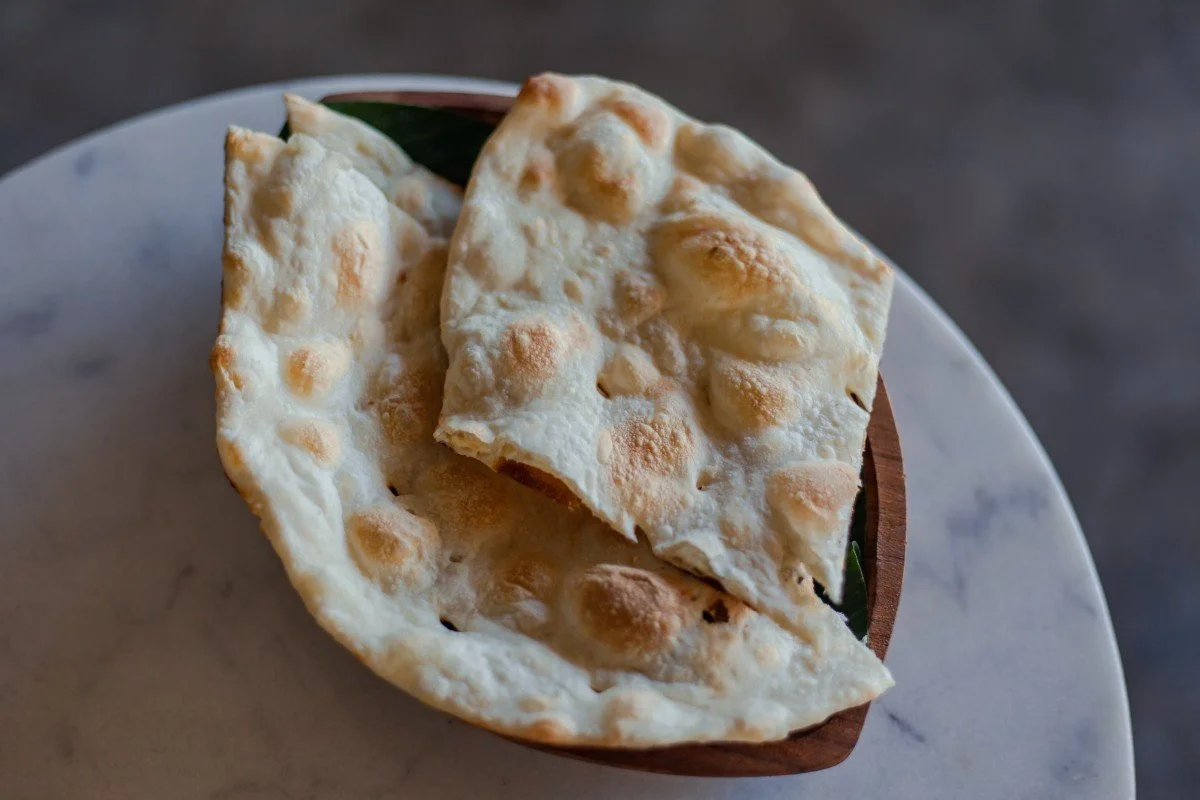
Start by tearing off a piece that is comfortable for one bite.
You do not need a huge section. A smaller piece is generally easier to control, particularly with a curry that has plenty of sauce.
Hold the naan between your fingertips and fold it gently. The fold creates a small surface that can scoop or pinch food from your plate.
Then gather a little curry.
With a thick curry, you might pick up some sauce and a small piece of chicken or paneer together. With dal, you can use the naan to collect a smaller amount across its surface.
The goal is not to soak the bread completely. Too much sauce can make the piece difficult to hold and can overpower the balance between bread and curry.
Take one bite, then tear another piece.
It is simple, relaxed, and one of the reasons freshly baked Indian bread works so naturally with a meal designed around several dishes.
Do You Have to Eat Naan with Your Hands?
No.
Eating Indian flatbreads by hand is traditional in many Indian dining contexts, but using cutlery is also common, particularly in restaurants.
If you would like to follow a more traditional approach, food is generally eaten with the right hand in many parts of India. Dining customs vary considerably across regions, communities, households, and individuals, so it is better to understand this as a widespread tradition rather than a universal rule.
For someone trying Indian food for the first time, comfort matters more than trying to perform the meal perfectly.
You can tear naan with your fingers and eat the rest of your meal with a spoon and fork. You can use naan for some bites and rice for others. You can also simply use cutlery throughout the meal.
Indian dining should feel enjoyable, not intimidating.
Naan and Curry Work Together Because of Texture
A good pairing is not only about flavour.
Texture matters just as much.
Thicker tomato-based or lentil curries naturally cling to naan. The bread gives the sauce something substantial to sit on while adding a mild, warm flavour of its own.
Take a rich curry such as Burrata Butter Chicken. The tomato-based butter sauce has enough body to sit comfortably on a torn piece of naan. Add a small piece of chicken, and the naan brings sauce, protein, and bread together in a single bite.
A lentil preparation works differently but follows the same principle. Dal Makhani with Burrata has a softer, slower-cooked texture. Naan can pick up a small amount while providing contrast to the creamy lentils.
This is one reason naan should not automatically be treated as something you eat before the main course. It makes more sense alongside the dishes it is intended to accompany.
Should You Choose Naan or Rice with Curry?
There is no need to declare one better than the other.
They create different eating experiences.
Naan is particularly satisfying with thicker curries because you can tear it, scoop with it, and combine several textures in one bite.
Rice handles sauce differently. Individual grains absorb and distribute curry, which can work especially well with lighter or more fluid gravies.
At Pesona Lounge Ubud, our curry dishes are currently served with local rice, while naan can be added separately from the bread section of the current menu.
That means you do not necessarily have to choose.
Try some of the curry with rice first, then use naan for another bite. Comparing the two is actually an easy way to notice how much the accompaniment changes your perception of exactly the same curry.
Which Naan Should You Order?
Not every naan tastes the same, and the best choice depends on what else is on the table.
Butter Naan
Butter Naan is the most straightforward place to begin.
At Pesona Lounge Ubud, it is served soft from the tandoor and brushed with ghee. Its relatively simple flavour means the curry remains the focus.
It is particularly useful when your curry already has plenty happening in the sauce.
Try it with Burrata Butter Chicken, Paneer Masala, Dal Makhani with Burrata, or Lamb Rogan Josh.
Garlic Naan
Garlic Naan adds another savoury layer.
That can work particularly well with tomato-based curries such as Chicken Tikka Masala or Paneer Masala, where the garlic complements rather than completely changes the character of the sauce.
If you enjoy stronger flavours, this is an easy progression from Butter Naan.
Garlic & Cheese Naan
Adding cheese makes the bread richer and more substantial.
Because of that, it does not necessarily need the richest curry on the table. Pairing a very creamy naan with an equally rich curry can make each component harder to distinguish.
Consider sharing one alongside the meal rather than automatically using it for every curry.
Keema Lamb Naan
Keema Lamb Naan is filled with spiced minced lamb, which means it already brings considerable flavour and protein of its own.
Think of it less as a neutral vehicle for curry and more as another component of the meal.
It can be eaten between bites of other dishes or shared around the table without needing to carry a large amount of sauce.
Peshwari Naan
Peshwari Naan takes the experience in another direction.
The version currently served at Pesona Lounge Ubud contains cashews and dried cranberries, giving it a sweeter profile than Butter or Garlic Naan.
That sweetness means pairing becomes more personal. Some diners enjoy the contrast with savoury and spiced dishes, while others prefer eating it separately.
There is no reason every naan on the table needs to perform the same job.
Which Pesona Curries Work Well with Naan?
The easiest way to choose is to think about sauce rather than trying to memorise pairing rules.
Our Burrata Butter Chicken has a rich butter chicken sauce finished with creamy burrata. Butter Naan keeps the pairing relatively simple and gives you something soft for gathering the tomato-based sauce.
Chicken Tikka Masala combines grilled chicken with a bold tomato gravy. Garlic Naan adds another savoury element and works well when you want a more pronounced bread flavour.
Paneer Masala places paneer in a rich spiced tomato gravy. Both Butter Naan and Garlic Naan are practical choices because the paneer and sauce can be picked up together.
Dal Makhani with Burrata is made with slow-cooked black lentils and finished with burrata. A torn piece of naan gives this softer dish more textural contrast.
Other curries may make you reach for rice first.
Goan Fish Curry, for example, is described on our current menu as a lighter, tangy coconut curry. Chicken Curry Madras and Lamb Curry Madras also use coconut milk and curry leaves. Rice can be particularly comfortable with these more fluid sauces, although there is nothing stopping you from adding naan as well.
The point is not to find one mathematically perfect pairing. It is to understand what each accompaniment contributes.
For more guidance on ordering different styles of dishes, our practical guide to Indian food in Ubud explains curries, tandoori dishes, breads, rice, spice levels, and regional influences in more detail.
A Small Etiquette Tip for Shared Meals
Indian meals are often enjoyable when several dishes are placed in the middle of the table and everyone can try a little of each.
If you are sharing, a useful habit is to move some curry onto your own plate before eating it with naan.
That keeps the communal serving dishes separate from the hand or utensils you are actively eating with, while also making scooping much easier.
It also means you can build each bite at your own pace instead of reaching repeatedly across the table.
For a first Indian meal, sharing several contrasting dishes can be more interesting than ordering several versions of the same flavour profile.
If heat is something you are unsure about, our guide to how spicy Indian food really is explains why aromatic spice and chilli heat are not the same thing.
There Is No Naan Examination at the End of Dinner
Knowing the traditional way to enjoy a dish can make the experience more interesting, but it should not make dinner feel restrictive.
Tear naan if you want to scoop your curry.
Use rice when you want the grains to carry the sauce.
Use a spoon when that feels easier.
Alternate between all three.
Food traditions provide context, not a reason to worry about every movement at the table.
The next time warm naan arrives beside your curry, try tearing off a small piece rather than cutting the whole bread. Fold it slightly, pick up just enough curry for one bite, and notice what happens to the texture and flavour.
That small change is often enough to explain why naan and curry have become such a satisfying combination.
Frequently Asked Questions
What is the correct way to eat naan?
One common traditional method is to tear off a bite-sized piece, fold it slightly, and use it to scoop curry, dal, vegetables, paneer, or meat. There is no universal rule, and using cutlery is also perfectly acceptable.
Why do people tear naan instead of cutting it?
Tearing allows you to create small pieces as you eat. Those pieces can then be folded and used to pick up a manageable amount of curry or another dish.
Do you dip naan directly into curry?
You can use naan to collect curry from your own plate. When eating from shared dishes, transferring some food onto your plate first is a cleaner and more comfortable approach.
Do you eat naan with your right or left hand?
In many traditional Indian dining contexts, the right hand is preferred for eating. Customs differ across India and between individuals, and restaurant dining today often includes cutlery as well.
Is naan better with curry than rice?
Neither is universally better. Naan is particularly useful for thicker sauces and hands-on eating, while rice absorbs and distributes sauce differently. Many diners enjoy both during the same meal.
Can I eat naan with Butter Chicken?
Yes. A thick tomato-based butter chicken sauce is particularly easy to scoop with naan. Pesona Lounge Ubud currently serves Burrata Butter Chicken, which can be paired with Butter Naan or another naan from the menu.