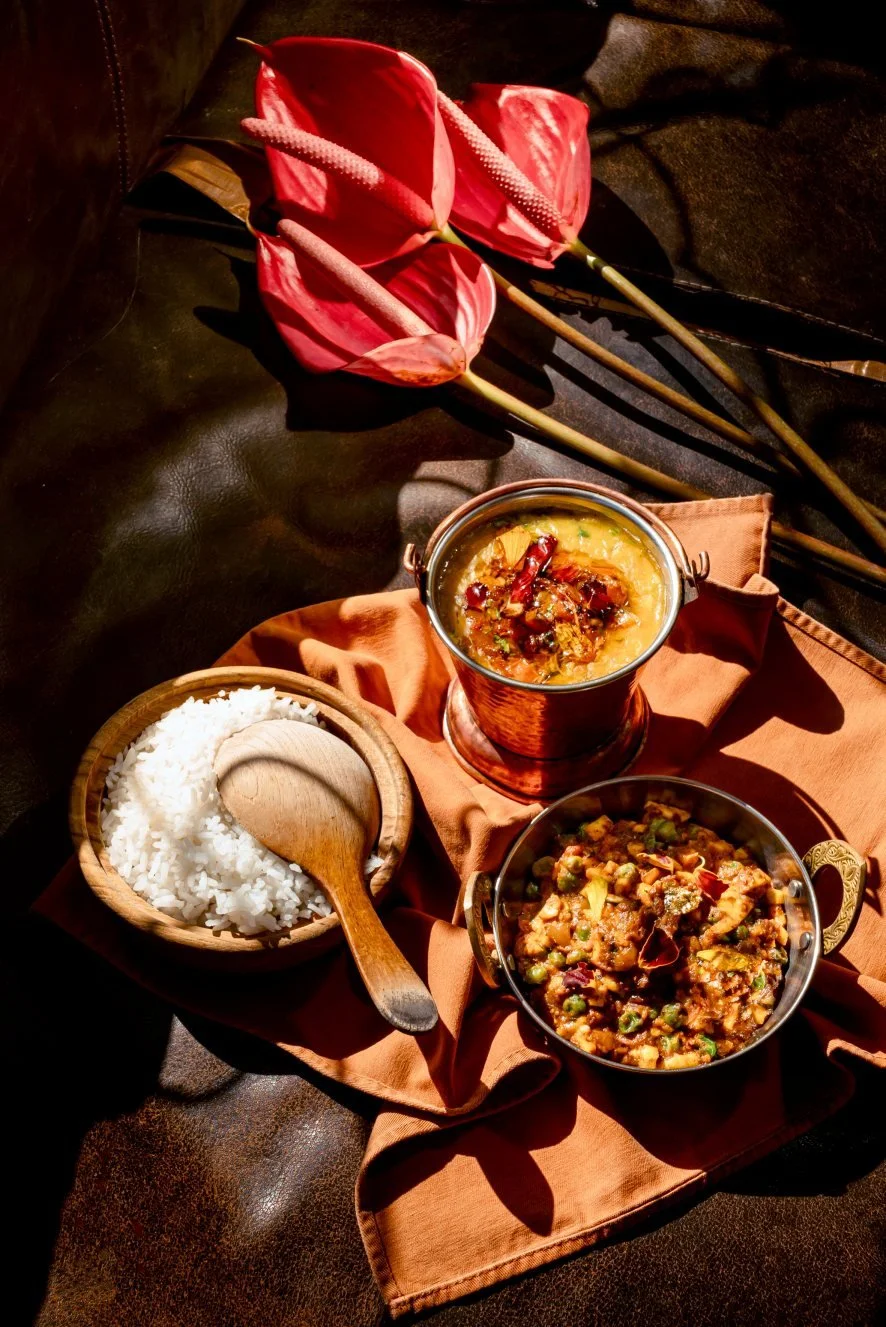
Your food arrives, along with a few smaller bowls. One looks creamy, another is green, and there’s something darker beside the starter.
Do you pour them over everything? Dip your food into them? Leave them alone until someone explains?
Hello, small bowls. You deserve a little more attention.
When eating Indian food, accompaniments can change the flavour and texture of each mouthful. Dahi is plain yoghurt, raita is a seasoned yoghurt preparation, and chutney is a broader family of condiments made with ingredients such as herbs, vegetables or fruit. They serve different purposes, so it helps to know which one is on your table.
At Pesona Lounge Ubud, we make our yoghurt in-house. Our menu also includes House Masala Raita and several chutneys served with particular dishes. Here’s how to understand those accompaniments and enjoy them without guessing.
Dahi: the plain yoghurt beside your meal
Dahi is the term you’ll often encounter for yoghurt in Indian food. In an English-language menu, it may also be described as curd.
At Pesona, our plain yoghurt is homemade. That is a specific part of our kitchen preparation, alongside the paneer we also make in-house.
Think of plain dahi as an accompaniment that brings a creamy texture and a tangy dairy flavour without the additional seasoning you would expect from raita.
You can place a small amount beside your food, combine it with a mouthful of rice, or alternate between the main dish and the yoghurt. There’s no need to pour the entire bowl into your meal immediately.
Keeping some separate gives you control. You can enjoy the main preparation on its own, then add yoghurt when you want a different balance.
That distinction becomes particularly useful with a dish whose rice already carries its own seasoning.
Why our Vegetable Dum Biryani comes with dahi
Pesona’s Vegetable Dum Biryani is sealed in pastry, baked, opened at the table and served with dahi.
The yoghurt is an accompaniment to the biryani rather than another layer of rice or a curry to pour over it. It gives you something different to add as you eat.
Start with a spoonful of the biryani itself. Then try another with a little dahi. You may prefer the contrast, or you may enjoy alternating between them.
Adding a small amount at a time also helps preserve the distinctions within the rice dish. Once you have mixed yoghurt through the whole serving, you cannot taste the original preparation separately.
Our guide to biryani explains how rice, seasoning and cooking methods contribute to the dish. The accompaniment gives you another way to enjoy that preparation at the table.
Raita: yoghurt with more going on
Raita starts with yoghurt and adds seasoning or other ingredients. Depending on the recipe, it may include vegetables, herbs, spices or fruit.
That makes raita a prepared side dish rather than simply another name for plain yoghurt.
At Pesona Lounge Ubud, House Masala Raita is listed separately on the menu. If you want plain yoghurt, look for dahi; if you want the seasoned preparation, choose raita.
Don’t assume every raita is a cucumber raita. Cucumber is one familiar variation, but recipes differ considerably. Nor should a pale, creamy appearance be taken as proof that a preparation contains no chilli.
For your meal, the practical choice is whether you want yoghurt in its plain form or an accompaniment with additional flavour.
You can see both options in the sides section of our current food menu.
Chutney is a category, not one particular sauce
Chutney can be made with herbs, vegetables, fruit and spices. It may be smooth or textured, fresh-tasting or cooked, sweet, tangy, hot, or a combination of those qualities.
In other words, knowing that something is chutney tells you less than knowing which chutney it is.
Mint chutney and coconut chutney offer different starting ingredients. A tamarind preparation takes another direction again. The name is your first clue, but the complete recipe determines the final flavour.
Even chutneys with the same name can vary between kitchens. Mint chutney, for example, has both yoghurt-based and dairy-free variations.
That is why colour alone is not a reliable guide to ingredients or heat. A green accompaniment could contain chilli, yoghurt or other ingredients you wouldn’t identify just by looking at it.
For enjoyment, start with a little. For a dietary requirement, establish the ingredients before tasting.
Mint and tamarind chutneys with Aloo Tikki
Our Aloo Tikki is served with mint and tamarind chutneys.
The potato patty gives you the main bite; the accompaniments let you vary what you add to it.
One easy approach is to divide a piece and try the chutneys separately. You can then decide whether you prefer one, both together, or just a small amount alongside the potato.
This is particularly useful when sharing. Someone else at the table may want much more chutney than you do, so there is little reason to cover the whole shared serving before everyone has tried it.
Use a spoon to transfer a little to your own plate. That leaves the remaining accompaniment available for everyone and makes it easier to control the amount.
You’re not expected to finish every condiment in a fixed proportion. Their role is to give you choices as you eat.
Coconut and tomato chutneys with masala dosa
At Pesona, our Masala Dosa comes with sambar, coconut chutney and tomato chutney.
These are distinct accompaniments. Sambar is a lentil-and-vegetable preparation; it is not simply another chutney.
The dosa and potato filling give you one combination of textures, while the sides introduce additional moisture and flavour. You can dip a small piece, spoon an accompaniment onto your plate, or alternate between them.
If you particularly enjoy the crisp parts of the dosa, add accompaniments to each bite as you eat. Covering the whole dosa with a wet preparation changes that texture.
There is also no need to combine all three sides every time. Try a little coconut chutney with one bite and tomato chutney with another, then return to whichever combination you prefer.
For the dish itself, our masala dosa guide explains the filling, batter and serving style in more detail.
House chutneys with the tandoori grill
Our Tandoori Grill section includes local rice and house chutneys.
With a grilled dish, the accompaniment lets you add moisture and seasoning to individual bites. You can enjoy some of the food on its own and use chutney with the rest.
Rather than coating everything at the beginning, place a small amount beside your serving. This gives you a chance to experience the grilled preparation before deciding how much accompaniment you want.
If you are choosing between a grilled main and a saucier dish, our tandoori-versus-curry guide can help. The role of the accompaniment is part of that decision: a chutney served alongside grilled food gives you a different eating experience from a main surrounded by gravy.
Do you need to order extra sides?
Check what comes with your main first.
Some dishes already have a specific accompaniment listed. Others leave room for an optional side, depending on your preferences and how much food you want.
If you have chosen something served with dahi, you may not also want a separate yoghurt-based side. Equally, you might deliberately choose raita because you prefer a seasoned preparation.
There is no requirement to collect every accompaniment on the menu.
For a shared meal, decide which extras the table will actually enjoy. One person may want yoghurt while another prefers chutney. Ordering with those preferences in mind is more useful than adding sides automatically.
Our Indian dinner for two guide offers more help with planning the wider order.
Check the side as well as the main
An accompaniment is part of the meal, so dietary requirements apply to it too.
Dahi and conventional yoghurt-based raita contain dairy. Chutneys need individual consideration because recipes vary; a herb-based name does not establish that a preparation is vegan.
The same principle applies if you avoid onion, garlic or another ingredient. A suitable main does not automatically make every accompanying sauce suitable.
Tell the team your requirements before ordering so the complete plate can be considered. If you have an allergy, identify it clearly rather than relying on the appearance or name of the condiment.
A few quick answers
What is the difference between dahi and raita?
Dahi is yoghurt. Raita is a prepared yoghurt-based side with added seasoning or other ingredients.
Does Pesona Lounge Ubud make its own yoghurt?
Yes. Our yoghurt is made in-house, as is our paneer.
Should I mix chutney into the entire dish?
You can, but starting with a small amount on your own plate gives you more control over the flavour and texture.
Is every green chutney dairy-free?
No. Some mint chutney recipes use yoghurt. Check the specific preparation if you avoid dairy.
Is sambar a chutney?
No. It is a lentil-and-vegetable preparation commonly served alongside dishes such as dosa.
Give the small bowls a chance
You don’t need to memorise every name before enjoying Indian food. Knowing a few differences is enough to make the table feel more familiar.
Plain yoghurt, seasoned raita and different chutneys each give you another way to enjoy the dish you ordered. Start with a little, notice what you like, and build each bite accordingly.
You’ll find Pesona Lounge Ubud at Jl. Goutama Selatan No. 25A, Ubud.