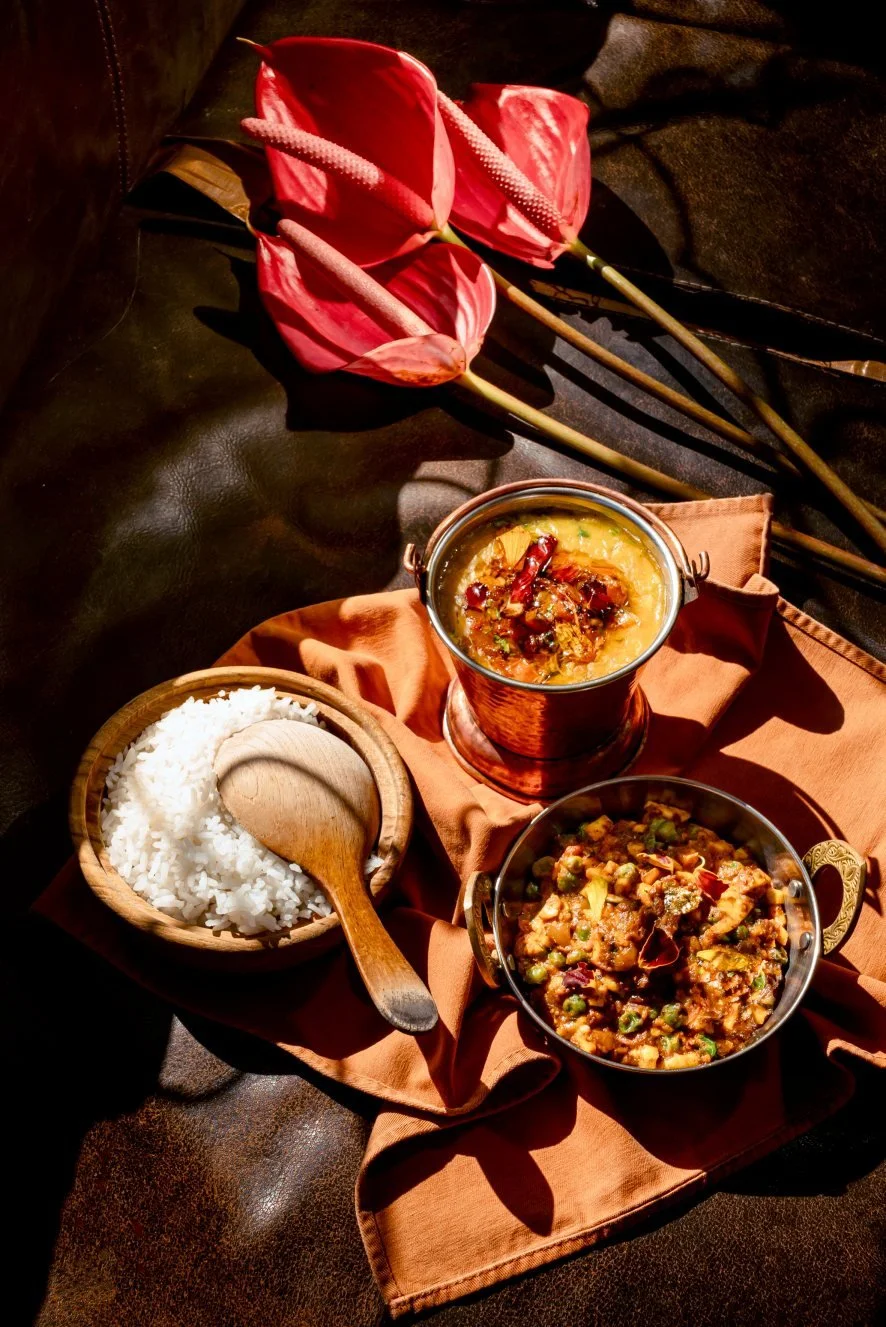
You’ve found an Indian restaurant, opened the menu, and spotted several dishes you would happily order. There’s just one detail to sort out: you don’t eat onion or garlic.
Does that leave you with plain rice for dinner? Not necessarily.
Pesona Lounge Ubud can prepare selected dishes without onion or garlic on request. We also offer options for guests following Jain, vegan, gluten-free and dairy-free diets. The suitable dishes depend on your complete requirements, so mention them before ordering.
For anyone searching for Indian food without onion and garlic in Ubud, the most useful starting point is understanding how your request relates to the whole meal. A curry, its bread and the chutney beside it may each need consideration.
Here’s how to plan an enjoyable dinner without turning the ordering process into a guessing game.
What does “without onion and garlic” mean for your order?
It means excluding those ingredients throughout the dish, rather than simply leaving sliced onion off the top.
That distinction matters when a meal includes several components. A main ingredient might suit your preferences while its sauce, seasoning or accompaniment needs a different preparation.
A clear request would be:
“Please prepare my meal without onion or garlic, including any paste, sauce, seasoning and garnish.”
If you only want to avoid raw onion but are comfortable with cooked onion, say that instead. Those are different requests, and neither should be inferred from the other.
You don’t need to know the kitchen’s terminology. What helps is being specific about the ingredients you avoid and whether the restriction applies to everything on your plate.
If the reason is an allergy, identify it as an allergy before ordering so the team can discuss ingredients and preparation with you.
What Pesona Lounge Ubud can offer
Our published dietary guidance confirms that selected dishes can be prepared without onion or garlic. This is a request-based option, rather than a statement that the entire menu is already prepared that way.
That gives you a useful way to approach the menu: first establish which preparations suit your requirements, then choose between them according to what you enjoy.
Would you prefer vegetables or paneer? Something with sauce, or a less saucy preparation? Rice, bread, or both?
You still get to have preferences beyond the ingredients you avoid.
Our food is made to order, with no premade meals, no added MSG, no pork and no lard. However, those kitchen practices answer different questions from whether an individual dish contains onion or garlic.
You can read more about our made-to-order approach to Indian food in Ubud.
Read the dish description before choosing
The menu already gives you several useful clues.
At Pesona, Onion Bhaji is built around onion. Paneer Bhurji lists onions alongside tomatoes and spices. Mung Dal Tadka includes garlic in its description, while Garlic Naan identifies it directly in the name.
These examples help you recognise which standard preparations don’t match a no-onion, no-garlic request.
They also illustrate why changing one dish may be more straightforward than changing another. Removing an ingredient that defines the dish can leave you with something very different from what attracted you to it.
Rather than settling on a dish and trying to remove its main features, begin with the preparations the kitchen can offer for your requirements. Then choose the one that sounds most enjoyable.
The absence of onion or garlic from a short description is not confirmation that neither is used. A menu summarises a dish; it rarely lists every ingredient.
Use our current menu to explore your preferences, then finalise the appropriate preparation before placing the order.
Vegetarian, vegan and no-onion-no-garlic are different requests
Wait, a vegetarian dish can still contain onion and garlic? Absolutely.
Vegetarian describes the exclusion of meat and fish. It doesn’t establish whether a dish contains either ingredient.
Vegan meals exclude animal-derived ingredients, including dairy, but can still contain onion and garlic. Conversely, a dish without onion or garlic may contain milk, yoghurt, butter or cheese.
At Pesona Lounge Ubud, we make our paneer and yoghurt in-house. That is part of our kitchen preparation, but both remain dairy products.
For someone who eats dairy, paneer may be an ingredient worth considering within a suitable preparation. For someone following a vegan diet, it is not an appropriate substitute for a plant-based main.
Our guide to paneer explains the ingredient in more detail.
If several requirements apply, state them together. “Vegetarian, without onion or garlic, and dairy is fine” communicates a different order from “vegan, without onion or garlic.”
Is food without onion and garlic automatically Jain?
No. The terms should not be treated as interchangeable.
Traditional Jain dietary practice also avoids root vegetables such as potatoes and carrots. A vegetarian dish without onion or garlic could therefore still contain ingredients that don’t fit a guest’s Jain requirements.
Potato is a useful example when reading an Indian menu. At Pesona, it appears in dishes such as Aloo Gobi and Aloo Tikki, as well as the masala potato filling of our dosa. Omitting onion and garlic alone would not remove the potato.
Pesona offers Jain options, but the complete requirements should be discussed rather than reduced to those two ingredients.
If you follow additional observances or have specific restrictions for your visit, include them in your message. The aim is to agree on a suitable meal for your practice, rather than rely on a label that leaves important details unstated.
Remember the bread, chutneys and sides
Once the main is confirmed, give the accompanying food the same attention.
It’s easy to focus on a curry and then add bread without thinking about its topping. Garlic Naan is an obvious example, but fillings, sauces and side dishes deserve a check too.
You don’t need to turn every component into a separate conversation. Ask the team to confirm your complete order together:
“Could you please confirm that the main, bread and any chutneys served with it all follow the same requirement?”
If an accompaniment is unsuitable, establish whether it can be replaced or omitted before the plate reaches the table.
This also avoids a common misunderstanding: requesting “no onion garnish” when you actually need the whole meal prepared without onion.
The more clearly the order is agreed at the beginning, the easier it is to enjoy dinner when it arrives.
Choosing for flavour as well as dietary needs
Once you know your suitable options, describe the kind of meal you would enjoy.
Tell the team whether you want something rich or less rich, whether you like a generous amount of sauce, and how comfortable you are with chilli. Excluding onion and garlic does not communicate any of those preferences.
Someone may avoid both ingredients and still enjoy a noticeable chilli kick. Another guest may want the same exclusions and very gentle heat.
Avoid using “plain” unless that is genuinely what you want. It can suggest a broader reduction in seasoning than you intended.
A more useful description might be:
“I don’t eat onion or garlic, but I enjoy spices and moderate chilli. I’d prefer a vegetable dish with some sauce.”
That gives the kitchen a clearer picture of your preferences while leaving room to recommend an appropriate preparation.
Dining with people who have different requirements
A shared table doesn’t need one shared dietary rule.
If only one guest avoids onion and garlic, decide which dishes are intended for that person and which will be shared. Don’t assume that a dish ordered for everyone automatically follows the most restrictive requirement at the table.
An easy approach is to agree on a suitable main and accompaniment for the guest concerned, then add any shared dishes after confirming their ingredients.
Keep serving utensils with their respective dishes, particularly when the group has agreed to keep certain foods separate. This is a practical table arrangement, not a substitute for discussing allergy-related preparation with the restaurant.
And remember that sharing is optional. Ordering an individual meal can sometimes be more comfortable than checking every spoonful from several dishes.
For general portion planning, our Indian dinner for two guide can help you decide how much to order.
A message you can send before visiting
If you’re planning ahead, one concise message can cover the important details:
“Hello, I would like to visit Pesona Lounge Ubud on [date] at [time] for [number] guests. One guest needs vegetarian food without onion or garlic, including sauces and seasonings. Dairy is [fine/not suitable], and the other restrictions are [details]. Could you confirm suitable dishes and whether we need to arrange anything in advance?”
For a Jain request, include your complete exclusions rather than copying the vegetarian example unchanged.
Once you arrive, mention the agreed requirements again when ordering. This connects the advance conversation to the dishes you actually choose.
Frequently asked questions
Can I get Indian food without onion and garlic at Pesona Lounge Ubud?
Yes. Selected dishes can be prepared without onion or garlic on request. Explain your requirements before ordering.
Is the entire restaurant menu onion-free and garlic-free?
No. Several standard dishes include those ingredients. Suitable preparations need to be selected for your order.
Does homemade paneer mean the finished dish has no onion or garlic?
No. Homemade describes where the paneer is made. The ingredients used with it determine whether the complete dish meets your requirements.
Can I request both vegan food and no onion or garlic?
Tell the team that both requirements apply so they can confirm a suitable preparation. One description does not imply the other.
Where is Pesona Lounge Ubud?
We are at Jl. Goutama Selatan No. 25A, Ubud.
A clear order makes dinner easier
Knowing what you avoid is only the starting point. You should also be able to choose food that sounds enjoyable.
Begin with the complete dietary requirement, confirm the suitable preparations, then choose according to flavour, texture and appetite. That leaves fewer uncertainties at the table—and more time to enjoy your meal.